68%
Of roofing searches click organic results, not ads
3x
More leads from top-3 Google rankings vs page 2
$180
Average cost per roofing lead from paid ads
4–6mo
Typical timeline to reach page 1 for local keywords
Homeowners searching "roof replacement near me" or "roofing company [city]" are not browsing — they have a problem and they need it solved. If your roofing company isn't appearing in those results, a competitor is taking every one of those calls.
Roofing is one of the most competitive local service verticals online. High average ticket sizes ($8,000–$25,000 for a full replacement) make the stakes enormous — and they attract aggressive competition. The roofing companies winning on Google aren't the biggest or the oldest. They're the ones who understand how SEO works and execute it consistently.
This guide covers everything a roofing contractor needs to rank: local SEO, on-page optimization, keyword strategy, content, technical fundamentals, and link building. Work through it section by section and you'll have a clear action plan for outranking the competition in your market. For a full overview of roofing marketing beyond SEO, see our roofing industry marketing guide.
1) Why SEO Matters for Roofing Companies
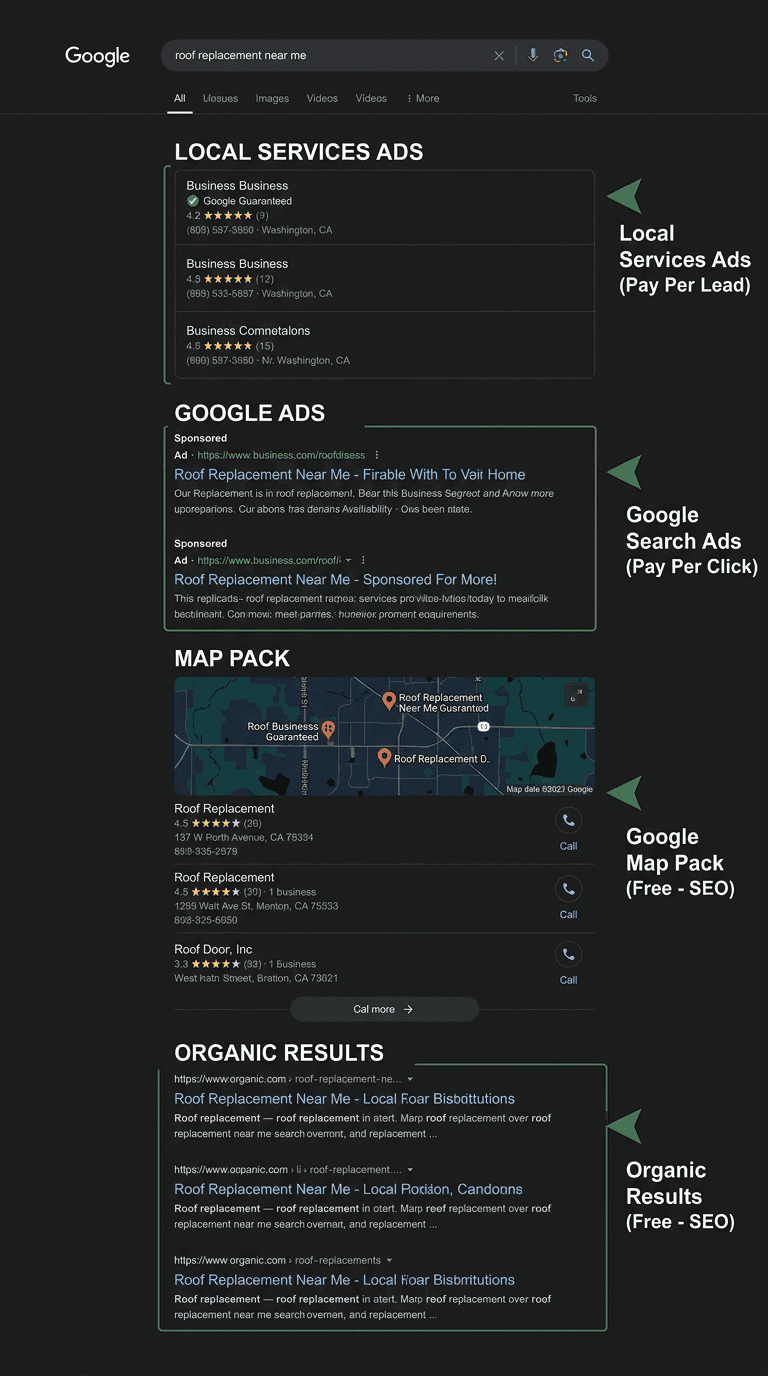
Paid advertising — Google Ads, Local Services Ads — delivers leads immediately, but the economics change the moment you stop spending. SEO is different. Rankings you earn today keep generating leads for months and years. The compounding effect is why the most profitable roofing companies in any market invest heavily in organic search.
Consider the math: a roofing company averaging $12,000 per job that closes 30% of its leads needs roughly 3–4 leads to book one job. If organic search delivers 20 leads per month at near-zero marginal cost, that's 5–6 additional jobs per month — without spending another dollar on ads. At $12,000 per job, that's $60,000–$72,000 in monthly revenue from a single channel.
| Google Ads | Organic SEO | |
|---|---|---|
| Lead cost (avg) | $120–$250 per lead | $15–$40 per lead (long-term) |
| Time to first lead | 1–3 days | 3–6 months |
| Stops when you... | Pause budget | Stop publishing/optimizing |
| Trust signal | Labeled as "Ad" | Earned organic placement |
| Scalability | Linear with budget | Compounds over time |
| Competition | Auction-based, rising CPC | Content and authority-based |
The Best Strategy Uses Both
Run Google Ads or Local Services Ads while your SEO builds momentum. Use paid traffic to generate immediate leads and fund the business while your organic rankings climb. Once SEO delivers consistent lead flow, you can reduce ad spend or reinvest it in growth.
Roofing also benefits from strong intent signals. Someone searching "emergency roof repair [city]" or "roof replacement cost" is not casually browsing. They have an urgent need and money to spend. SEO lets you capture that intent at scale without paying per click.
2) Local SEO: Dominate the Map Pack
The Google Map Pack — those three business listings that appear below the ads and above organic results — is the most valuable real estate in local search. Studies consistently show that Map Pack results capture 30–40% of all clicks on local search pages. For roofing companies, appearing in the top three is often more valuable than ranking #1 organically.
Google Business Profile Optimization
Your Google Business Profile (GBP) is the foundation of local SEO. An incomplete or poorly optimized profile is one of the most common reasons roofing companies don't appear in the Map Pack, even when they have a good website.
GBP Optimization Checklist
- Primary category: Set to "Roofing Contractor" — not a general contractor category
- Secondary categories: Add "Roofing Supply Store," "Gutter Cleaning Service," or "Skylight Contractor" as relevant
- Service area: List every city and zip code you serve — be specific
- Business description: 750 characters, include primary keywords naturally ("roofing company in [city]," "roof replacement," "storm damage repair")
- Services section: Add individual services with descriptions — roof replacement, repair, gutters, inspections
- Photos: Upload 20+ real job photos with geo-tagged images when possible; add exterior and team photos
- Q&A section: Seed with common questions ("Do you offer free estimates?") and answer them yourself
- Posts: Publish weekly GBP posts — project completions, seasonal tips, promotions
Reviews: The Map Pack Ranking Factor You Control
Review quantity, review recency, and review response rate are among the strongest signals Google uses to rank businesses in the Map Pack. A roofing company with 150 reviews averaging 4.8 stars will almost always outrank a competitor with 25 reviews and a 4.5-star average — even if the competitor has a better website.
Review Generation System for Roofers
- • Send a review request SMS within 2 hours of job completion — response rates drop sharply after 24 hours
- • Use a direct link to your GBP review form (find it in your Google Business Profile dashboard under "Ask for reviews")
- • Train every tech to mention reviews verbally before leaving: "If you're happy with the work, a Google review would really help us out"
- • Respond to every review within 24 hours — positive and negative. This signals to Google that your profile is actively managed
Local Citations
Citations are mentions of your business name, address, and phone number (NAP) on other websites — directories, local Chamber of Commerce listings, industry associations. Consistent NAP data across the web strengthens Google's confidence in your business information and supports local rankings.
Priority citation sources for roofing companies: Yelp, Angi (Angie's List), HomeAdvisor, Houzz, BBB, local Chamber of Commerce, Nextdoor Business, Thumbtack, and any regional business directories. Ensure your NAP is identical across all platforms — even minor variations (St. vs Street, LLC vs no LLC) can dilute citation value.
NAP Inconsistency Kills Local Rankings
If your GBP lists your number as (813) 444-9875 but your website footer shows 813-444-9875 and Yelp shows (813)444-9875, Google sees three different businesses. Audit your citations with a tool like BrightLocal or Moz Local and fix every discrepancy before you build new citations.
3) On-Page SEO for Roofing Websites
On-page SEO is the work you do on your own website to help Google understand what each page is about and which searches it should rank for. For roofing companies, this means building a page structure around your services and service areas — and then optimizing each page so Google has no ambiguity about what it covers.
The Right Page Structure
The biggest on-page mistake roofing companies make is cramming all their services onto one page. When Google crawls a single "Services" page listing roof replacement, repair, gutters, inspections, and storm damage, it has to guess which keyword the page should rank for. You end up ranking for nothing well.
Build a dedicated page for each service and each primary service area. A well-structured roofing site looks like this:
Core Service Pages
- • /roof-replacement — targets "roof replacement [city]", "new roof installation"
- • /roof-repair — targets "roof repair near me", "roof leak repair [city]"
- • /storm-damage-roof-repair — targets "storm damage roof repair", "insurance roof claim"
- • /gutter-installation — targets "gutter installation [city]", "seamless gutters"
- • /roof-inspection — targets "roof inspection near me", "free roof inspection"
- • /commercial-roofing — targets "commercial roofing contractor [city]"
Service Area Pages
- • /roofing-[primary-city] — main location page, most thorough
- • /roofing-[city-2], /roofing-[city-3] — surrounding areas
- • Each page unique content, not copy-paste with city name swapped
Title Tags and Meta Descriptions
Title tags are the single most important on-page SEO element. Every page needs a unique title tag that includes the primary keyword and your location. The format that works consistently for roofing:
Homepage
"[City] Roofing Company | [Company Name] — Licensed & Insured"
Service Page
"Roof Replacement in [City], [State] | [Company Name]"
Location Page
"Roofing Contractor in [City] | [Company Name]"
Keep title tags under 60 characters. Meta descriptions should be 150–160 characters, include a clear call to action ("Free estimates available" or "Call for same-day inspection"), and naturally include your primary keyword. Meta descriptions don't directly affect rankings but significantly impact click-through rates from search results.
Content Requirements Per Page
- H1 tag: One per page, contains the primary keyword (e.g., "Roof Replacement in Tampa, FL")
- Word count: 600–1,000 words minimum for service pages; location pages 500–800 words
- Keyword usage: Primary keyword in H1, first paragraph, one H2, and naturally throughout — no stuffing
- Local signals: Mention the city name, neighborhood names, nearby landmarks where natural
- Schema markup: LocalBusiness schema on every page (name, address, phone, service area, hours)
- Internal links: Link to related service pages and your main location page
- Clear CTA: Every page ends with a specific call to action — "Request a Free Inspection," "Get Your Roof Replacement Quote"
The One Sentence That Changes Everything
The first sentence of every service page should state exactly what you do and where: "We provide professional roof replacement services in [City], [State], with over [X] years of experience and [X]+ completed projects." This single sentence gives Google everything it needs to understand the page's purpose in the first 100 words.
4) Keyword Strategy for Roofers
Roofing keyword strategy is simpler than most industries because the intent is clear: people either need a roof fixed, replaced, or inspected. Your job is to map the right keywords to the right pages and prioritize by search volume, competition, and commercial intent.
High-Value Roofing Keywords
| Monthly Searches | Intent | Best Page | |
|---|---|---|---|
| roof replacement near me | 8,100 | Purchase | Homepage or roof replacement page |
| roofing company [city] | 1,900–5,400 | Purchase | Homepage or location page |
| roof repair near me | 6,600 | Purchase | Roof repair service page |
| roof leak repair | 4,400 | Purchase | Roof repair service page |
| storm damage roof repair | 2,900 | Purchase | Storm damage page |
| free roof inspection | 2,400 | Research | Roof inspection page |
| roof replacement cost | 18,100 | Research | Blog article or cost guide |
| how long does a roof last | 5,400 | Research | Blog article |
| metal roof vs shingles | 3,600 | Research | Blog comparison article |
Notice the split between purchase-intent keywords ("roofing company [city]") and research-intent keywords ("roof replacement cost"). Purchase-intent keywords belong on your service and location pages. Research-intent keywords belong on blog articles that capture homeowners earlier in the decision process and funnel them toward contact.
Long-Tail Opportunities
Long-tail keywords have lower search volume but much less competition and higher conversion rates. A roofer targeting "roof replacement cost in [specific city]" or "best roofing contractor [neighborhood]" will rank faster and attract more qualified traffic than going head-to-head with national aggregators on broad terms.
Long-Tail Keyword Examples to Target
- • "How much does roof replacement cost in [city]"
- • "Best roofing contractor [city] reviews"
- • "Emergency roof repair [city] same day"
- • "Roof repair after storm [state]"
- • "Metal roof installation cost [city]"
- • "TPO vs EPDM commercial roofing"
- • "Insurance claim roof replacement process"
- • "How to file insurance claim for roof damage"
Don't Keyword Stuff
Repeating "roofing company [city]" 20 times on a page doesn't help rankings — it hurts them. Google's algorithms are sophisticated enough to understand topical relevance. Write naturally, use semantic variations (roofer, roofing contractor, roofing services), and let the content depth signal expertise rather than keyword repetition.
5) Content Strategy That Ranks
Service and location pages capture homeowners who are ready to buy. But most roofing decisions start with research — homeowners searching for information before they contact anyone. A content strategy targets this research phase and positions your company as the trusted expert before they're even ready to get quotes.
Blog content also supports your service page rankings. Google evaluates the topical authority of your entire site when deciding how to rank individual pages. A roofing company with 20 articles covering roofing topics has stronger topical authority than a competitor with only service pages — and that authority lifts every page on the site.
Content Topics by Funnel Stage
Top of Funnel (Awareness)
- • "Signs You Need a New Roof"
- • "How Long Does a Roof Last?"
- • "Metal Roof vs Asphalt Shingles"
- • "What Roofing Materials Are Best?"
Middle of Funnel (Consideration)
- • "Roof Replacement Cost in [City]"
- • "How to File a Roof Insurance Claim"
- • "Questions to Ask Your Roofer"
- • "How to Compare Roofing Quotes"
Bottom of Funnel (Decision)
- • "Best Roofing Company in [City]"
- • "[Company Name] Reviews"
- • "[City] Roofing Contractor Comparison"
- • Case studies: real project results
What Makes Roofing Content Actually Rank
Google prioritizes content that demonstrates genuine expertise. For roofing articles, this means including specific details that only someone with real field experience would know: typical cost ranges for your region, common mistakes homeowners make when choosing a roofer, what to expect during a replacement project, how to read a roofing estimate.
The Local Angle Always Wins
Generic roofing content competes with national publishers and industry sites that have massive domain authority. You can't win that fight. But "Roof Replacement Cost in [Your City] — [Year] Pricing Guide" is a keyword you can own. Localize every content piece you publish. Mention regional weather patterns, local building codes, common roofing materials in your area, and local permit requirements.
Content Publishing Cadence
Consistency matters more than volume. Publishing two high-quality, 1,500+ word articles per month outperforms publishing ten thin 300-word posts. Build a content calendar targeting one or two target keywords per article, and focus on topics where you can genuinely add value — real project photos, local pricing data, specific advice your competitors haven't covered.
6) Technical SEO Essentials
Technical SEO is the foundation everything else is built on. It's what allows Google to crawl, index, and properly understand your site. A roofing website can have great content and strong local signals but still underperform in rankings due to technical issues that prevent Google from accessing or evaluating the content correctly.
Page Speed: Mobile First
Over 70% of roofing searches happen on mobile. Google uses mobile-first indexing, meaning it ranks your site based on the mobile version. Run your site through Google PageSpeed Insights (pagespeed.web.dev) and target a score above 70 on mobile. The biggest wins: compress and resize images, eliminate render-blocking JavaScript, and upgrade from cheap shared hosting.
Core Web Vitals
Google measures three performance metrics that directly affect rankings: Largest Contentful Paint (LCP, target under 2.5s), Cumulative Layout Shift (CLS, target under 0.1), and Interaction to Next Paint (INP, target under 200ms). Check your scores in Google Search Console under 'Core Web Vitals.' These are actionable — a web developer can fix most issues in a few hours.
HTTPS and Security
Your site must use HTTPS (the padlock icon). Google treats non-HTTPS sites as security risks and demotes them in rankings. Most hosts offer free SSL certificates through Let's Encrypt. If your site still shows HTTP, contact your host or web developer immediately — this is a foundational issue.
Crawlability and Indexing
Open Google Search Console and check the Coverage report. Look for pages marked 'Excluded' or 'Error.' Common issues: pages blocked by robots.txt, duplicate content from www vs non-www versions, pages accidentally set to noindex. Every service and location page should be indexed. If pages are missing from the index, that's revenue sitting on the table.
XML Sitemap
Submit an XML sitemap to Google Search Console. This tells Google every page on your site and when it was last updated. Most CMS platforms (WordPress, Squarespace) generate sitemaps automatically. Make sure your sitemap is submitted in Search Console and doesn't include pages you don't want indexed.
Schema Markup
Add LocalBusiness schema to your homepage and location pages. This structured data tells Google your business name, address, phone number, service area, operating hours, and price range. Add Service schema to each service page. While schema doesn't directly boost rankings, it helps Google understand your business and can unlock rich result features in search.
Website Builders Can Limit Technical SEO
Platforms like Wix and Squarespace have improved significantly but still lag behind WordPress and custom builds on technical SEO flexibility. If you're on a website builder and struggling with page speed, schema implementation, or crawl issues, it may be time to consider a purpose-built roofing website. Our website development service is designed specifically for contractors who need SEO-ready sites.
7) Link Building for Roofers
Backlinks — other websites linking to yours — remain one of Google's strongest ranking signals. A link from a reputable local website tells Google that your site is trustworthy and relevant. For roofing companies competing in local markets, you don't need links from national media outlets. You need links from local and industry-relevant sources.
Link Building Strategies That Work for Roofers
Local Business Directories and Associations
Join your local Chamber of Commerce and get listed on their member directory (almost always includes a backlink). Same for the BBB, local homebuilders associations, and roofing industry associations like the National Roofing Contractors Association (NRCA) and your state's roofing contractor association.
Supplier and Manufacturer Pages
GAF, Owens Corning, CertainTeed, and other roofing manufacturers maintain "Find a Contractor" directories on their websites. If you're a certified installer, you should be listed. These are authoritative sites with strong domain authority and the links carry real weight.
Local News and Community Coverage
Sponsor a local youth sports team, donate materials for a community project, or participate in a storm-damage relief effort. Local news sites often cover these stories with links. One link from a local newspaper's website can be worth more than 50 directory links.
Real Estate and Home Inspector Partnerships
Build relationships with local real estate agents and home inspectors who recommend contractors to their clients. Many have websites or blogs where they list preferred vendors. A referral relationship often comes with a link, and it generates leads directly as well.
Guest Content on Local Publications
Offer to write a roofing tips article for a local home and garden publication, neighborhood blog, or community newsletter. "5 Signs Your Roof Won't Survive Hurricane Season in [City]" is genuinely useful content that local publishers will run. You get a byline, a link, and exposure to a local audience.
Start With What You Already Have
Before building new links, audit what you've already earned. Search Google for mentions of your company name that don't include a link — these are "unlinked mentions." Reach out to the site owner and ask them to add a link. This is the easiest backlink you can get because the person already knows and mentioned your business.
Avoid Link Schemes
Buying links, participating in private blog networks (PBNs), or exchanging links with unrelated sites are tactics that violate Google's guidelines. When Google detects them — and it usually does — the penalty can wipe out years of ranking progress. Every backlink strategy in this section is white-hat and sustainable.
8) Measuring Your SEO Results
SEO without measurement is guesswork. You need to track the right metrics to know what's working, where to double down, and whether your investment is generating a return. The good news: the core measurement tools — including Google Search Console and Google Analytics — are free.
Essential SEO Measurement Tools
| What It Measures | Cost | |
|---|---|---|
| Google Search Console | Keyword rankings, impressions, clicks, indexing issues | Free |
| Google Analytics 4 | Traffic, conversions, user behavior, lead sources | Free |
| Google Business Profile Insights | Map Pack impressions, direction requests, calls from GBP | Free |
| Ahrefs / SEMrush | Keyword tracking, competitor analysis, backlink monitoring | $100–$200/mo |
| CallRail | Call tracking — which SEO pages generate calls | $45–$95/mo |
KPIs to Track Monthly
- Organic sessions: Total visits from non-paid search. Should grow month over month as rankings improve
- Keyword rankings: Track 10–20 target keywords (your primary services + city). Are you moving up or down?
- Google Business Profile calls: Calls directly from your GBP listing in the Map Pack
- GBP impressions: How many times your GBP appeared in search or maps results
- Organic form fills: Lead forms submitted by visitors who arrived from organic search
- Organic call volume: Use call tracking to isolate calls from organic traffic
- Cost per organic lead: Total SEO investment ÷ organic leads. Track this monthly to measure ROI
Setting Realistic Expectations
SEO is not a switch — it's a ramp. Month 1–2 is foundation work: technical fixes, on-page optimization, GBP improvements. Month 3–4 is when you start seeing movement in rankings. Month 5–6 is typically when organic lead volume becomes meaningful. Month 12+ is when the full ROI of the investment becomes apparent.
Set a 6-month benchmark: if you've done the work in this guide consistently, you should be ranking in the top 5 for your primary city keywords and generating at least 10–15 organic leads per month. If you're not, audit what's missing — it's almost always one of three things: weak GBP, insufficient content, or not enough backlinks.
Monthly SEO Review Routine
- • Check Search Console for any new indexing errors or manual actions
- • Review keyword ranking changes for top 20 target keywords
- • Track GBP impressions and call volume vs. prior month
- • Count organic leads from GA4 (filter by organic/search source)
- • Publish at least one new content piece or update an existing page
- • Check review count and respond to any new reviews
For a deeper look at the full range of marketing metrics roofing companies should track — including paid search, GBP, and overall ROI — this framework also applies directly to roofing. See our SEO service page for details on how we manage roofing and contractor SEO campaigns.
Frequently Asked Questions
How long does SEO take for a roofing company?
Most roofing companies see meaningful ranking improvements in 3-6 months with consistent effort. Local SEO (Google Business Profile, reviews) can show results faster — often within 4-8 weeks. Competitive markets may take 6-12 months for top positions on high-volume keywords.
How much should a roofer spend on SEO?
Budget $1,500-$3,000/month for professional roofing SEO. This should cover local SEO, on-page optimization, content creation, and link building. Companies in competitive markets may need $3,000-$5,000/month to compete effectively.
Is SEO or Google Ads better for roofers?
Both serve different purposes. Google Ads delivers immediate leads but stops when you stop paying. SEO builds long-term organic traffic that compounds over time. The best strategy uses both — Google Ads for immediate lead flow while SEO builds momentum.
What are the most important ranking factors for roofing companies?
Google Business Profile optimization, consistent reviews, local citations, mobile-friendly website speed, service-area specific content, and quality backlinks from local sources are the biggest ranking factors for local roofing searches.
The Bottom Line
Roofing SEO is not magic — it's a system. Optimize your Google Business Profile and build reviews. Build dedicated pages for every service and service area. Target the right keywords in your title tags and content. Fix the technical issues that prevent Google from properly evaluating your site. Earn links from local and industry sources. Track your results and double down on what's working.
Every one of these steps is straightforward in isolation. The challenge is executing them consistently while running a roofing business. That's where most companies stall — not from lack of knowledge, but from lack of time and accountability.
If you want to know exactly where your roofing website stands today — what's working, what's holding you back, and what to fix first — start with a free audit. You'll get a real assessment of your speed, SEO, and conversion performance with specific recommendations you can act on immediately. No fluff, no sales pitch — just data.
If you'd rather have a team handle it, our roofing SEO service covers everything in this guide — implemented, tracked, and optimized every month. And if your site needs a rebuild before SEO makes sense, our contractor website development service builds SEO-ready sites designed to convert roofing leads.