
$30–$80
Average cost per lead from Google Ads (general plumbing)
3–5x
More leads for companies using multiple channels
78%
Of emergency callers hire the first plumber who answers
50–70%
Close rate on referral leads vs. 20–35% for paid channels
Plumbing is one of the most competitive home service markets in Google Ads — and one of the most lucrative when your lead generation system actually works. A single repiping job or sewer line replacement can produce $5,000–$15,000 in revenue. But most plumbing companies are either bleeding budget on poorly structured Google Ads campaigns, relying entirely on referrals that plateau, or handing money to aggregator sites with no idea what their real cost per booked job is.
The plumbing lead generation challenge is unique: you need to capture both emergency calls — burst pipes at 2 AM, backed-up sewer lines on a holiday — and planned, high-value services like water heater replacement, repiping, and drain cleaning memberships. These two lead types require different strategies, different ad copy, and different website experiences.
This guide covers every major plumbing lead generation channel with honest cost benchmarks and real tradeoffs. We'll compare Google Ads, local SEO, Local Services Ads, and referral systems — and give you a framework for figuring out which combination is right for your market. For broader context on plumbing marketing, see our plumbing industry marketing guide.
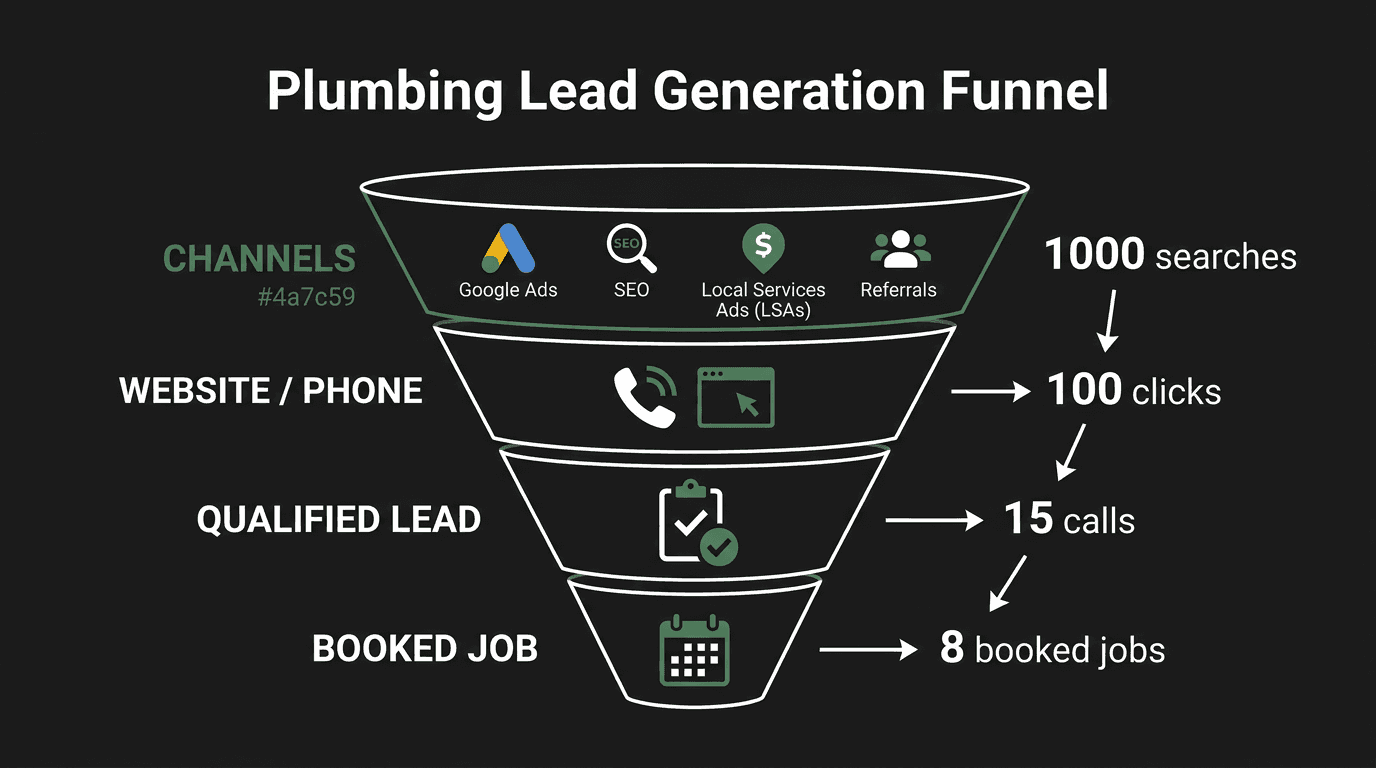
1) The Plumbing Lead Generation Landscape
Before diving into individual channels, it helps to understand what makes plumbing lead generation different from other trades. Plumbing leads fall into two fundamentally different categories — emergency and planned — and they require different acquisition strategies, different close rates, and different economics.
Emergency Leads
Burst pipes, water heater failures, clogged drains, gas leaks — homeowners need help immediately and will call the first plumber who answers. Emergency leads have the highest close rates (often 70–85%) because the homeowner is not comparison shopping. Speed-to-answer is the primary competitive variable. These leads skew toward smaller ticket items unless there's significant damage.
Planned Service Leads
Water heater replacement, repiping, sewer line inspection, drain cleaning membership — these are considered purchases where homeowners research options, compare prices, and take a day or two to decide. Lower close rates (25–45%) but dramatically higher average job values. High-value jobs like repiping ($4,000–$15,000) are won on trust and reviews, not just speed.
A third dimension is lead source — whether leads are owned, rented, or shared. This distinction determines your long-term economics more than any other factor.
Owned Leads
Leads generated through your own website, Google Business Profile, and organic rankings. You pay acquisition costs upfront (SEO, time) but own the relationship. Highest close rates, best long-term economics, no per-lead variable cost once established.
Rented Leads
Leads from platforms where you pay to access their audience — Google Ads, Local Services Ads, Facebook Ads. Fast to launch, scalable, fully measurable. Economics depend on your cost per click, conversion rate, and average job value.
Shared Leads
Leads purchased from aggregators like HomeAdvisor, Angi, or Thumbtack. The same lead goes to 3–5 plumbing companies simultaneously. Low per-lead cost but dramatically lower close rates — you're competing on price and who calls first.
| Google Ads | Local SEO | LSAs | HomeAdvisor/Angi | |
|---|---|---|---|---|
| Avg. cost per lead | $30–$80 | $10–$30 (long-term) | $20–$50 | $15–$40 |
| Time to first lead | 1–3 days | 3–6 months | 2–4 weeks | Same day |
| Lead exclusivity | Yes | Yes | Yes | No (3–5 competitors) |
| Typical close rate | 25–40% | 35–50% | 25–40% | 5–15% |
| Emergency call capture | Excellent | Good | Good | Poor |
| Stops when paused | Immediately | No (rankings persist) | Immediately | Immediately |
Calculate Cost Per Booked Job, Not Cost Per Lead
Aggregator leads at $20 each look cheap until you factor in a 10% close rate: you're paying $200 per booked job. A Google Ads lead at $60 with a 35% close rate costs you $171 per booked job — and that customer found you exclusively. Always run the math on cost per booked job across channels before making budget decisions.
2) Google Ads for Plumbing Leads
Google Search Ads are the fastest way to get plumbing leads at scale. When someone types "emergency plumber near me" or "water heater replacement [city]," they have already decided they need a plumber. Your ad is reaching someone in active decision mode — the highest-value moment in the buying journey.
Plumbing is an expensive vertical in Google Ads, but less so than roofing or HVAC in most markets. Clicks for general plumbing keywords run $8–$25 in mid-size markets, and $20–$45 in major metros. Emergency keywords like "emergency plumber" and "burst pipe plumber" command premium CPCs because the intent is extremely high. At a 6–10% landing page conversion rate, you can expect $80–$400 per lead depending on your market, campaign structure, and page quality.
Structuring Plumbing Campaigns for High-Value Services
The biggest mistake plumbing companies make in Google Ads is treating all services as equal. A drain cleaning lead is worth $150–$300. A repiping lead is worth $4,000–$15,000. These should not be in the same campaign, with the same bids, sending traffic to the same landing page.
Segment by Service and Job Value
Create separate campaigns for emergency services, water heater replacement, repiping, drain cleaning, and sewer services. Bid more aggressively on high-value services — you can afford a $150 lead cost for a repiping job that pays $8,000. Emergency campaigns should use call-only ads and bid highest during nights and weekends when competition drops but intent stays high.
Call-Only Ads for Emergency Keywords
For "emergency plumber," "burst pipe repair," and "plumber open now," use call-only ad formats that skip the landing page entirely and dial your number directly. Emergency callers want to talk to someone immediately — not read a landing page. Call-only campaigns for emergency keywords typically convert at 2–3x the rate of standard text ads sending traffic to a website.
Aggressive Negative Keyword Lists
Plumbing campaigns attract irrelevant clicks from searches like "plumbing supplies near me," "plumbing pipe sizes," "DIY drain unclogging," "plumbing license requirements," and "plumbing apprenticeships." Build a negative keyword list of 150+ terms before launch, and expand weekly from the search terms report. This alone cuts wasted spend by 25–35% in most plumbing accounts.
Service-Specific Landing Pages
A homeowner who searched for "water heater replacement cost" should land on a page dedicated to water heater services — with your price range, warranty information, brands you carry, and a clear CTA. Sending all plumbing traffic to your homepage increases bounce rates and kills Quality Scores, which raises your CPC. Each major service deserves its own dedicated landing page.
Bid Adjustments for Peak Demand Hours
Emergency plumbing calls spike on Monday mornings (weekend backlog), Friday afternoons (before the weekend), and holiday periods when other plumbers are unavailable. Increase bid adjustments by 20–40% during these windows. Also increase bids for mobile devices — over 75% of plumbing emergency searches happen on phones, and mobile callers convert at higher rates than desktop searchers for emergency services.
Google Search Ads for Plumbing — Full Assessment
Pros
Cons
Franchise Competitors Change the Math
Plumbing is dominated by national franchises — Roto-Rooter, Mr. Rooter, Benjamin Franklin — with massive Google Ads budgets and established Quality Scores. In major markets, they can afford to bid $35–$50 per click on broad plumbing terms. Rather than competing head-to-head on generic keywords, focus on specific service terms ("tankless water heater installation," "trenchless sewer repair") and geographic qualifiers where franchise brand recognition matters less and your local reputation wins. See our Google Ads management service for details on how we structure campaigns against franchise competitors.
3) Local SEO & Map Pack
Local SEO is the highest-ROI lead generation investment a plumbing company can make over a 12–24 month horizon. A plumber ranking in the top three of the Google Map Pack for "plumber near me" generates 30–50 organic calls per month without paying per click. The economics are transformational compared to any paid channel at scale.
The Map Pack captures 30–40% of all clicks on local plumbing search pages. For emergency searches specifically, where homeowners pick from the first results they see, Map Pack visibility is often the most valuable real estate in the market. Appearing there is driven by three primary factors: Google Business Profile optimization, review velocity and rating, and website authority for local plumbing keywords.
Google Business Profile Optimization for Plumbers
GBP Lead Generation Checklist for Plumbers
- Set accurate service categories: "Plumber" as your primary category, with secondary categories for drain cleaning, water heater repair, sewer services — each category expands the searches you appear for
- Enable messaging: Turn on Google Messages so homeowners can text directly from your listing — many prefer texting for non-emergency inquiries like "what's your price for water heater installation?"
- List all services with descriptions: Add every service you offer with 2–3 sentence descriptions — drain cleaning, water heater installation, sewer line repair, repiping, leak detection — each description is indexed text that expands your local search footprint
- Q&A seeding: Add and answer the 5 most common homeowner questions: "Do you offer 24/7 emergency service?," "Are you licensed and insured?," "Do you offer free estimates?," "What brands of water heaters do you install?," "Do you do same-day service?"
- Post completed job photos weekly: Before/after photos of water heater installations, pipe repairs, and drain cleaning jobs — labeled with city and service type in the filename and description
- Update hours for holiday availability: If you offer emergency service on holidays, mark your GBP as open — many plumbers leave their holiday hours blank, meaning Google shows them as "possibly closed" exactly when emergency call volume spikes
Review Volume as a Lead Generation Engine
A plumber with 300 reviews at 4.8 stars is visually dominant in the Map Pack. When a homeowner is looking at three plumbers side by side — 12 reviews, 47 reviews, and 312 reviews — the call goes to the one with 312, almost every time. Reviews do double duty: they improve Map Pack ranking and convert undecided searchers into callers.
The fastest review-building process for plumbing companies: send a direct Google review link via SMS within two hours of job completion, train technicians to verbally ask before leaving ("If everything looks good, would you mind leaving us a quick Google review? It really helps small businesses like ours"), and respond to every review within 24 hours. Companies that execute this consistently add 4–8 reviews per week and see meaningful Map Pack movement within 60–90 days.
Rank for High-Value Service Keywords, Not Just 'Plumber Near Me'
The most profitable SEO targets for plumbing companies are not generic terms but high-value service keywords: "water heater replacement [city]," "repiping company [city]," "trenchless sewer repair [city]." These searches have lower volume but much higher average job values — and less competition than generic "plumber near me" queries. A single page ranking for "repiping company Tampa" can produce $50,000+ in annual revenue. For a full breakdown of plumbing SEO strategy, see our local SEO for plumbers guide.
Local SEO for Plumbing Leads — Full Assessment
Pros
Cons
4) Local Services Ads (LSAs)
Local Services Ads appear above both Google Ads and organic results and display a "Google Guaranteed" badge — a trust signal that carries significant weight with homeowners deciding who to call. You pay per lead, not per click, and can dispute leads that are clearly wrong numbers, out-of-area, or irrelevant. For plumbing companies, LSA leads typically run $20–$50 — lower than standard Google Ads on a per-lead basis.
The Google Guaranteed badge matters particularly in plumbing because of the trust deficit that exists in the trade. Homeowners have been burned by unlicensed or dishonest plumbers before. A verified badge signals background checks, licensing, and insurance — and in a search result page with four plumbing companies, it creates immediate visual differentiation.
Getting Approved for Google Guaranteed
LSA Verification Requirements for Plumbers
- • Valid state plumbing contractor license (license number required during application)
- • General liability insurance with minimum coverage limits (typically $500K–$1M)
- • Background checks for all business owners and employees who enter customer homes
- • Minimum 5 Google reviews to be approved for the badge
- • Third-party verification process managed by Google's partner (Evident or similar)
The approval process takes 2–4 weeks. Once live, LSA ranking is determined by review count, review rating, response time, and your bid per lead. Unlike Google Ads, you don't manage keywords — Google matches your listing to relevant plumbing searches based on your selected services and service area. This makes LSAs lower-maintenance than standard Google Ads but also gives you less control.
Maximizing Lead Volume From LSAs
- Answer every LSA call within 2 minutes: Google tracks response time and ranks faster responders higher — a 5-minute response vs. a 20-second response can be the difference between appearing first or fourth in your market
- Select all relevant services: Drain cleaning, water heater installation, pipe repair, sewer services, emergency plumbing — each service you add expands the search queries your listing can appear for
- Dispute bad leads within 30 days: Wrong numbers, duplicate leads, out-of-area requests, and calls under 30 seconds are all disputable — most plumbers leave 15–25% of their lead credits on the table by not disputing
- Send LSA review requests after every job: Reviews requested through your LSA dashboard count toward both your LSA ranking and your standard Google Business Profile — double value from a single request
- Set precise service area zip codes: Overly broad service areas generate out-of-range leads and waste dispute credits while hurting your account health metrics
Local Services Ads for Plumbing — Full Assessment
Pros
Cons
For most plumbing companies, running LSAs and Google Ads simultaneously produces better results than either channel alone. LSAs capture the top-of-page trust position, Google Ads fill coverage gaps with service-specific campaigns, and together they dominate the paid real estate on plumbing search pages. Our Google Ads for plumbers guide covers how to structure both channels to work together.
5) Converting Website Visitors
Every lead generation channel eventually sends traffic to your website. Your website is the bottleneck in the whole system — the conversion layer that determines how many of those visitors actually contact you. A 3% conversion rate means 97 out of every 100 visitors leave without calling. Improving that to 6% doubles your leads from every channel simultaneously, without changing a single dollar of your ad spend or a single position in your SEO rankings.
Most plumbing websites underconvert for two reasons: they were designed to look professional rather than to generate calls, and they treat emergency and planned service visitors the same. The homeowner with a burst pipe and the homeowner researching water heater replacement cost have completely different needs and time horizons — and both converting well requires different pages, different copy, and different CTAs.
Conversion Optimization for Emergency vs. Planned Service Traffic
Phone Number Everywhere, Click-to-Call on Mobile
Your phone number should be in the navigation bar, in the hero section, and at the bottom of every page — with tap-to-call links on mobile. Emergency plumbing callers are not scrolling to find your contact page. The average homeowner with a plumbing emergency spends under 20 seconds on a page before deciding to call or leave. Make the number visible within 2 seconds of landing.
Emergency Service Page With Separate URL
Create a dedicated emergency plumbing page (/emergency-plumber) with its own headline, phone number in the hero, guaranteed response time, and zero distractions. Run emergency Google Ads and call-only campaigns to this page or the call extension directly. Homeowners searching at midnight need to see '24/7 Emergency Plumber — We Answer Every Call' and a phone number. Not your company history.
High-Value Service Pages With Trust Signals
Repiping, water heater replacement, and sewer line repair are considered purchases. Build dedicated service pages that answer the questions homeowners research: What does it cost? How long does it take? Do you offer financing? What brands do you use? What's your warranty? Include your license number, review count with star rating, and photos of completed work. These pages need to build enough trust for someone to call rather than request multiple quotes.
Speed Under 3 Seconds on Mobile
Over 70% of plumbing searches happen on mobile devices. A site that takes 6 seconds to load loses 50% of visitors before they see your phone number. Emergency callers on a slow 4G connection will not wait. Target a Google PageSpeed mobile score above 70 and an actual load time under 3 seconds. This single improvement can lift conversion rates 15–30% without changing any copy or design.
Minimal Forms — 5 Fields Maximum
A plumbing lead form should ask for: name, phone, email, service needed, and a brief message. Every additional field reduces form completion rates. If a homeowner is describing a plumbing emergency in a 10-field form at 11 PM, they will abandon it and call a competitor. Collect additional information during the follow-up call. The form's only job is to get a name and phone number.
Social Proof Above the Fold on Every Page
A Google review widget displaying your rating and recent reviews near the top of each page reduces the trust barrier before visitors reach your CTA. A plumber with '4.9 stars from 287 reviews' displayed prominently in the hero section communicates in 3 seconds what a paragraph of copy takes 30 seconds to convey. Especially important for high-value services where the homeowner's decision involves significant money.
Upfront Pricing Signals Where Possible
Homeowners researching plumbing services want to know if you're in their budget before they call. Showing price ranges ('Water heater installation starting at $1,200' or 'Free estimates for all plumbing work') pre-qualifies leads and reduces the number of shoppers who call only to be surprised by your rates. This actually improves lead quality even if it slightly reduces call volume.
Your Website Is Probably Your Biggest Lead Problem
When plumbing companies say their Google Ads "don't work," the ads are usually fine — the website is the problem. Audit your conversion rate in Google Analytics: divide tracked calls and form submissions by total sessions. If you're below 4% for a plumbing site, your website is your bottleneck, not your ad spend. See our plumbing advertising guide for how landing page quality impacts paid campaign ROI.
6) Building Referral Systems
Referrals are the highest-quality leads in plumbing. A homeowner referred by a neighbor arrives with trust already established — they're not comparing quotes, they're calling to confirm your availability and pricing. Referral close rates in plumbing typically run 50–70%, compared to 25–40% for Google Ads leads. For high-value services like repiping or water heater replacement, referred customers also tend to have larger budgets and fewer price objections.
The challenge is that most plumbing companies rely on referrals passively — they happen when satisfied customers volunteer to recommend you, which is unpredictable and unscalable. A systematic referral program converts that passive goodwill into a reliable lead channel you can actually plan around.
Post-Job Referral System
The 4-Touch Referral Sequence
- • Day of job completion: Technician verbally asks ("If you're happy with the work, we'd really appreciate a Google review and a referral to any neighbors who need plumbing help") and leaves a referral card with an incentive ("Refer a neighbor — you both get $50 off your next service")
- • Within 2 hours: SMS review request with direct Google review link and personal message from the technician by name
- • Day 7 follow-up: Text or email checking on the repair and reminding the customer of the referral program with a direct link to share
- • Annual maintenance reminder: Seasonal email or postcard reminding past customers of your maintenance services and referral offer — plumbing is a repeat-service business and past customers are your warmest audience
Professional Referral Partner Networks
Beyond homeowner referrals, professional partnerships can produce consistent, high-quality lead flow. Plumbing has unusually strong referral partner opportunities because plumbing issues surface in so many professional contexts — real estate transactions, home sales, insurance claims, and property management.
High-Value Referral Partners for Plumbers
- • Real estate agents: Encounter plumbing inspection failures and repair requirements on virtually every transaction — a trusted plumber who responds fast is invaluable to busy agents
- • Home inspectors: Identify plumbing defects on every inspection and need reliable contractors to recommend to buyers and sellers
- • General contractors and remodelers: Kitchen and bathroom remodels always need plumbing rough-in — subcontracting relationships with busy GCs can provide steady, higher-ticket work
- • Property management companies: Manage dozens to hundreds of units and need a reliable emergency plumber on call — one relationship can produce 10–30 jobs per month
- • Insurance restoration companies: Water damage claims require plumbing diagnosis and repair — referral relationships with restoration companies access a stream of insurance-backed work
- • HVAC companies: Non-competing home service businesses who serve the same homeowners — cross-referral agreements benefit both parties
One Property Manager Relationship Can Be Worth $100K/Year
A property management company with 200 units and a preferred plumber gets 2–3 service calls per unit per year at a $200–$400 average ticket — that's $80,000–$240,000 in annual revenue from a single relationship. Identify the three largest property managers in your market, offer a competitive service agreement with guaranteed response times, and treat them like your most important client. These relationships compound for years with no ongoing marketing cost.
Owned vs. Rented Leads — Long-Term Economics
Pros
Cons
7) Measuring Lead Quality & ROI
Generating leads is only half of plumbing lead generation. The other half is measuring which leads actually turn into revenue — and at what cost. A channel that produces 60 leads per month with an 8% close rate and a $200 average ticket generates $960 in revenue per ten leads. A channel that produces 20 leads with a 40% close rate and an $800 average ticket generates $6,400 per ten leads. Without tracking this by source, you're flying blind on budget allocation.
Key Metrics to Track by Lead Source
| Metric | Why It Matters | |
|---|---|---|
| Close rate by channel | Reveals which sources produce serious buyers vs. price shoppers | |
| Average job value by channel | Emergency channels produce small tickets; planned service channels produce large jobs | |
| Cost per booked job | True ROI metric — lead cost ÷ close rate, accounts for quality differences | |
| Revenue per lead | Close rate × average job value — the single best cross-channel comparison | |
| Time to close by channel | Emergency leads close same-day; repiping leads may take 3–7 days — affects cash flow | |
| No-show / cancel rate | High cancellation rates signal either low-quality leads or slow follow-up speed |
Setting Up Lead Attribution
Minimum Attribution Stack for Plumbers
- • Call tracking (CallRail or similar): Assign unique phone numbers to Google Ads, LSAs, your website homepage, and offline sources — all route to your main line but track separately. Most plumbing leads call; without call tracking you can't attribute them.
- • Google Analytics 4: Track all form submissions as conversion events with source/medium attribution — connect to Google Ads to see cost and conversion data in one place
- • CRM with mandatory source field: Every new lead in your CRM gets a source tag (Google Ads, LSA, Organic, Referral — specify who, HomeAdvisor, etc.) — this is where you connect lead source to closed jobs and revenue
- • Monthly channel review: Pull leads, estimates sent, jobs booked, and revenue by source every month — recalculate cost per booked job for each paid channel monthly and reallocate accordingly
The Aggregator Problem: Why Shared Leads Hurt Margins
HomeAdvisor, Angi, and Thumbtack generate high lead volume in plumbing markets, but the economics are structurally hostile to profitability. When a homeowner submits a request on any of these platforms, the lead is immediately sent to 3–5 plumbing companies. The homeowner receives multiple calls within minutes and makes a decision based primarily on who calls first and who quotes lowest.
This dynamic creates a race to the bottom: you need to be the fastest caller (dropping everything the moment a lead arrives) and the cheapest option. Plumbers who rely heavily on aggregator leads find themselves working harder and harder for thinner and thinner margins — chasing volume while their close rates erode. And every dollar spent on these platforms builds the aggregator's brand, not yours.
Aggregator Lead Traps to Avoid
Three specific aggregator traps cost plumbing companies significant money: (1) Annual contracts — many platforms offer discounts for 12-month commitments before you know if leads convert in your market. Never commit to more than 30 days until you've measured close rates. (2) Lead reselling without disclosure — some platforms sell the same lead to more than the stated number of contractors. If you're consistently calling within 5 minutes but homeowners say "I already have 6 plumbers calling me," the platform is overselling leads. Dispute and document this. (3) Automatic billing escalation — platforms increase lead budgets automatically without notification, often doubling spend during peak demand. Set hard spending caps and review weekly.
Speed to Lead: The Variable That Matters Most
Across every lead source in plumbing, response time is the single biggest variable in close rates outside of price. Industry research consistently shows leads contacted within 5 minutes of submission are 9x more likely to convert than leads contacted after 30 minutes. For emergency plumbing specifically, 78% of callers hire the first plumber who answers — not the best-reviewed, not the cheapest, the first one to pick up.
9x
Higher conversion if contacted within 5 minutes of inquiry
78%
Of emergency callers hire the first plumber who answers
5 min
Target response time for all inbound leads during business hours
$50–$120
Average CPL for high-value services (repiping, water heater)
Speed to lead is a process problem, not a marketing problem. If your dispatcher is busy, your owner handles all sales calls, or leads go to voicemail after hours, your best campaigns are quietly losing business to competitors who answer faster. Build a lead response protocol: all inbound calls and form submissions get a response within 5 minutes during business hours, within 30 minutes after hours. If that requires an answering service or dedicated call coordinator, the cost is almost always justified by the incremental close rate improvement.
Frequently Asked Questions
What is the best way to get plumbing leads?
The highest-quality plumbing leads come from Google Search Ads and Local Services Ads targeting emergency and high-intent keywords. Local SEO builds a long-term lead engine that compounds over time. Combining both channels with a conversion-optimized website and active review management creates a sustainable, multi-source lead pipeline.
How much do plumbing leads cost?
Plumbing leads from Google Ads cost $30–$75 each depending on competition and keyword. Local Services Ads typically run $20–$50 per lead. Organic SEO leads cost $10–$25 long-term once rankings are established. Lead generation services (Angi, HomeAdvisor, Thumbtack) charge $15–$60 per lead but vary widely in quality.
How do I get more plumbing customers fast?
The fastest path to more plumbing customers is running Google Search Ads or Local Services Ads targeting "plumber near me" and emergency keywords in your service area. These can generate leads within 24–48 hours of campaign launch. Pair this with a conversion-optimized website and a fast phone response to maximize lead-to-booking conversion rates.
The Bottom Line
Plumbing lead generation is not a single tactic — it's a system built around two fundamentally different lead types. Emergency leads require speed, 24/7 availability, and paid channels that can capture high-intent searches immediately. Planned service leads — repiping, water heater replacement, sewer repair — require trust, detailed service pages, strong reviews, and local SEO authority that ranks for high-value service keywords.
The plumbing companies winning in competitive markets run Google Ads and LSAs for immediate paid leads, build local SEO for long-term organic volume, and invest in systematic referral programs for the highest close rates in their pipeline. They track every lead to its source, calculate cost per booked job for each channel, and reallocate budget monthly toward what's working. They do not rely on aggregator platforms as their primary strategy, because shared leads with 10% close rates are a trap — not a foundation.
If you want to know exactly where your plumbing website and marketing stack stand today — which channels are profitable, where you're losing leads, and what your closest competitors are doing differently — start with a free audit. You'll get a specific, prioritized assessment you can act on immediately.
If you'd rather have a team build and manage the system, our Google Ads management and local SEO service are built specifically for home service companies who want to dominate their market without managing campaigns themselves.