76%
Of local service searches result in a phone call within 24 hours
3x
More leads from Map Pack vs. organic-only presence for electricians
$95
Average cost per electrical lead from paid ads — vs. near zero from organic
2–4mo
Typical timeline to see meaningful Map Pack improvement
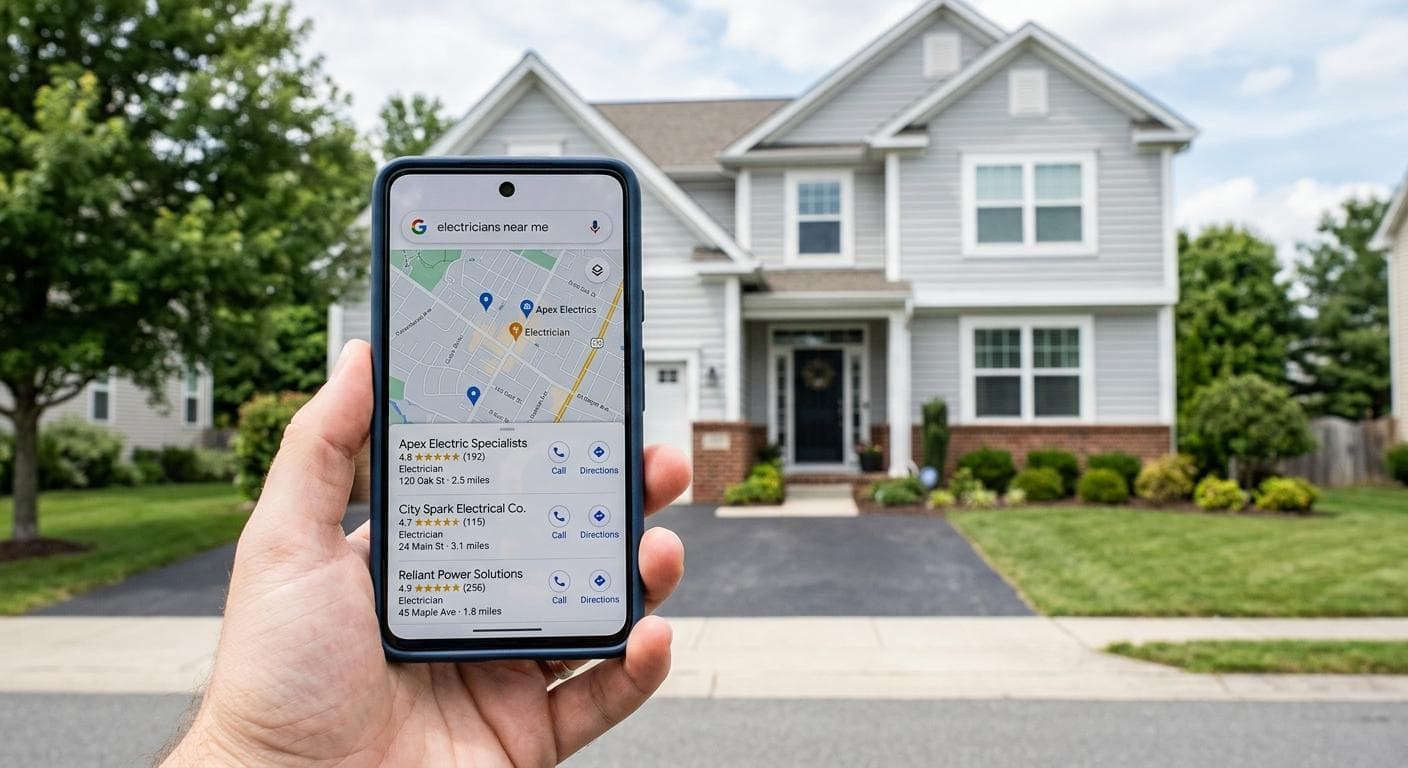
When a homeowner smells burning plastic near their panel or a business owner needs EV chargers installed before their new fleet arrives, they open Google and call the first electrician they trust. Local SEO is the discipline of making sure that electrician is you — appearing in the Map Pack and organic results before your competitors do.
Unlike Google Ads, which stop delivering the moment your budget runs out, local SEO builds a compounding asset. Every GBP optimization, every service area page, every citation and review accumulates into a search presence that generates calls month after month without ongoing ad spend. The electricians dominating local search in competitive markets got there through consistency, not magic.
This guide covers every element of local SEO for electricians: Google Business Profile optimization, keyword strategy, service area page architecture, citation building, review systems, and on-page essentials. For a broader look at marketing channels including paid ads and social, see our electrical contractor industry overview. For deeper coverage of the full SEO picture, see our companion guide on electrician SEO.
1) Why Local SEO Matters for Electricians
Electrical work is hyper-local. A homeowner in Tampa is not hiring an electrician from Miami, and a business in Phoenix is not calling a contractor based in Scottsdale without a strong local presence. The geographic constraint that might seem like a limitation is actually your competitive advantage: if you can dominate local search in your service area, you have a near-monopoly on organic leads from that geography.
The economics make local SEO particularly compelling for electricians. High-ticket services — 200-amp panel upgrades ($2,500–$4,500), whole-house rewiring ($8,000–$15,000), generator installation ($5,000–$12,000), EV charger installation ($800–$2,500) — mean that ranking for even a handful of local keywords produces significant revenue. A single top-3 Map Pack position for "electrician [city]" can generate 10–20 calls per month at zero ongoing cost once established.
| Local SEO | Google Ads | |
|---|---|---|
| Lead cost (mature) | $8–$25 per lead | $80–$150 per lead |
| Time to first lead | 2–6 months | 1–3 days |
| Stops when you... | Stop optimizing (slowly) | Pause budget (immediately) |
| Trust perception | Earned placement — high trust | Labeled as Ad — lower trust |
| ROI over time | Compounds — improves monthly | Flat — tied to spend |
| Best for | Sustained long-term lead flow | Immediate results, new markets |
Local SEO and Paid Ads Work Best Together
Run Google Ads or Local Services Ads while your local SEO builds. Once organic rankings mature — typically months 4–6 — you can reduce ad spend or reallocate it toward higher-margin services like commercial electrical work. Most electricians find that the two channels together deliver the lowest blended cost per lead, with SEO handling volume and paid ads filling the gaps during slow periods. See our guide on electrician marketing for how the channels interact.
Local SEO also carries a trust dimension that paid ads cannot replicate. An electrician who ranks organically and appears in the Map Pack with 80+ reviews averaging 4.8 stars communicates competence and reliability before a homeowner ever visits the website. That earned credibility converts at higher rates and at lower pressure than a click from an ad labeled as paid placement.
2) Google Business Profile for Electricians
Your Google Business Profile (GBP) is the most important single asset in local SEO. It controls your Map Pack appearance, displays your reviews and photos directly in search results, and serves as the primary way Google verifies your business is legitimate and relevant. An incomplete or neglected GBP is the most common reason electricians fail to appear in the top 3 local results.
GBP Setup and Optimization for Electricians
Choose the Right Primary Category
Select 'Electrician' as your primary GBP category — not 'Contractor,' 'Home Services,' or 'Handyman.' The primary category is the most powerful relevance signal Google uses to match your listing to searches. Add secondary categories for specialized services: 'Electric Vehicle Charging Station Contractor,' 'Solar Energy Contractor,' 'Generator Shop,' or 'Lighting Contractor' as applicable to your actual service mix.
Complete Every Profile Section
Fill in your business description (use the full 750 characters — include 'electrician in [city],' your state license number, and primary services mentioned naturally), business hours with after-hours and emergency availability clearly marked, service area listing every city and zip code you serve, and a phone number that exactly matches what appears on your website.
Build Out the Services Section in Detail
Add individual service listings with keyword-rich descriptions: panel upgrades, EV charger installation, whole house rewiring, generator installation and maintenance, ceiling fan installation, outdoor and landscape lighting, electrical inspections, and commercial electrical work. Each service entry signals relevance for that specific search query and helps Google match your listing to detailed searches like 'EV charger installer near me.'
Upload Real Job Photos Consistently
GBP profiles with 100+ photos receive significantly more profile views and direction requests than those with fewer than 10. Upload before-and-after shots of panel upgrades, completed EV charger installations, generator hook-ups, rewiring projects, and outdoor lighting work. Add photos of your trucks with visible branding, your team in uniforms, and your license/certification plaques. Aim for 3–5 new photos per week.
Seed the Q&A Section Proactively
Add questions and answer them yourself before customers ask. Cover: 'Are you licensed and insured in [state]?' 'Do you offer free estimates?' 'Do you handle commercial electrical work?' 'Can you install Level 2 EV chargers?' 'Do you offer 24/7 emergency electrical service?' These appear publicly and target long-tail queries Google can match to your listing.
Publish GBP Posts Twice Per Month
Post updates, completed project photos, seasonal tips, and service promotions. Ideas: a panel upgrade job with before/after photos, 'EV charger installation special for [month],' an electrical safety tip before summer AC season, or a note about same-day emergency availability. Active, frequently updated profiles earn better local rankings than dormant ones.
Put Your License Number in Your GBP Description
Including your state electrical contractor license number directly in your GBP description accomplishes two things: it signals legitimacy to Google (verified, regulated business), and it reassures homeowners before they even click to your website. Most competitors skip this entirely. A description that reads "Licensed electrical contractor — FL License #EC13009999 — serving Tampa and surrounding areas since 2011" outperforms a generic description on both trust and relevance signals.
3) Local Keyword Strategy
Local keyword strategy for electricians divides into two buckets: high-intent "hire now" keywords that capture people ready to book a job, and service-specific keywords that capture people researching a particular project. Both are essential — the first fills your calendar this week, the second builds a pipeline of higher-value work.
The City + Service Formula
The foundation of local electrician keywords is simple: combine a service with a geographic modifier. "Electrician Tampa," "panel upgrade Orlando," "EV charger installation Phoenix." These combinations are highly specific, capture searchers who are ready to hire, and — unlike broad terms like "electrician" — are actually winnable against national directory sites like Angi and HomeAdvisor.
| Monthly Searches | Intent | Best Page | |
|---|---|---|---|
| electrician near me | 22,200 | Hire now | Homepage / GBP |
| electrician [city] | 500–5,400 | Hire now | Homepage / location page |
| local electrician [city] | 200–1,800 | Hire now | Homepage / location page |
| emergency electrician near me | 3,600 | Urgent hire | Emergency service page |
| panel upgrade [city] | 200–800 | High value | Panel upgrade service page |
| EV charger installation near me | 2,400 | Growing fast | EV charger service page |
| generator installation [city] | 400–1,200 | High value | Generator service page |
| electrical inspection near me | 1,300 | High intent | Inspection service page |
| whole house rewiring cost | 1,900 | Research | Rewiring page or blog |
Note the distinction between "hire now" keywords and "research" keywords. "Emergency electrician near me" belongs on a dedicated emergency page optimized for speed and urgent conversion. "Whole house rewiring cost" belongs on a detailed service page or blog article that walks through pricing, timeline, and what the project involves — it captures homeowners in the research phase and positions you as the expert before they call.
High-Value Service Keyword Clusters
Target Each of These with a Dedicated Page
- Panel upgrades: "200 amp panel upgrade [city]," "electrical panel replacement cost," "breaker box upgrade near me"
- EV charger installation: "EV charger installation near me," "level 2 charger install [city]," "Tesla wall charger installer near me"
- Whole house rewiring: "house rewiring [city]," "aluminum wiring replacement," "knob and tube wiring removal near me"
- Generator installation: "whole house generator installation [city]," "Generac installer near me," "standby generator installation cost"
- Commercial electrical: "commercial electrician [city]," "commercial electrical contractor," "commercial panel upgrade near me"
Avoid Unmodified Head Terms
"Electrician" and "electrical contractor" without a city or service modifier are dominated by national directories — Angi, HomeAdvisor, Thumbtack, and Yelp — with domain authority no local contractor can overcome. Always combine service + location ("electrician Tampa") or service + modifier ("EV charger installation near me"). These targeted combinations have less competition, higher conversion rates, and are genuinely achievable within 3–6 months of focused optimization.
4) Building Service Area Pages
If your GBP targets your primary city, service area pages extend your local SEO reach across every market you serve. A homeowner in a suburb searching "electrician [suburb name]" will not find your business unless you have a page that explicitly targets that location. Service area pages bridge that gap without requiring you to open a second physical location.
The most common mistake electricians make with location pages is duplicating content — copying the same text and swapping the city name. Google identifies this pattern immediately and deprioritizes or entirely ignores the pages. Every location page must contain genuinely unique content to earn a ranking.
Service Area Page Templates That Rank
City Electrician Page
Target: "electrician [city]" and "electrical contractor [city]." Unique content elements: mention specific neighborhoods or commercial districts in that city where you've completed work, reference the local building department and permit requirements for that municipality, include one real project example from that city, and embed a map showing your coverage. H1: "Electrician in [City], [State] — Licensed & Insured."
City + Service Page
Target: "panel upgrade [city]" or "EV charger installation [city]." Combine the service detail page structure with local specifics: local permit fees for that service in that city, notes about older housing stock or common electrical issues in that market, and a real completed project example. These pages have lower search volume but convert at extremely high rates because the intent is hyper-specific.
County or Region Page
Target broader geographic terms: "electrician [county] county" or "electrical contractor [region]." List every city within that county or region you serve, link to individual city pages, and describe the types of electrical work common in that area (older homes needing rewiring, new construction EV charger demand, commercial buildouts). Serves as a hub page connecting all city-level pages.
Neighborhood Electrician Page
For high-density metros where neighborhood-level searches are common. Target: "electrician [neighborhood]." Content focuses on housing age and electrical needs typical of that neighborhood (e.g., older homes that commonly need panel upgrades, new construction with EV charger rough-in). These pages have minimal competition and can rank within weeks.
How Many Location Pages Do You Need?
Build a page for every city or community you actively serve and could realistically get to within your normal dispatch range. For most electricians this means 5–15 pages. Do not build pages for cities you cannot realistically serve — Google is capable of identifying implausible service areas and may treat them as spam signals. Quality and uniqueness matter far more than quantity.
5) Citations & Directory Listings
A citation is any online mention of your business name, address, and phone number (NAP). Citations on authoritative directories signal to Google that your business is real, established, and trustworthy — all of which support local rankings. For electricians, citations on both general directories and electrical industry-specific platforms carry meaningful weight.
Priority Citation Sources for Electricians
| Priority | Notes | |
|---|---|---|
| Google Business Profile | Critical | The anchor citation — everything else reinforces this |
| Apple Maps / Bing Places | High | Second and third largest search engines after Google |
| Yelp Business | High | Ranks for local searches; homeowners read reviews here |
| Better Business Bureau (BBB) | High | Strong domain authority; trust signal for homeowners |
| Angi / HomeAdvisor | High | Referral leads + citation value — accept the free listing |
| Facebook Business Page | High | Social proof + citation; links to your site |
| Thumbtack | Medium | Citation value; additional lead channel |
| Nextdoor Business | Medium | Hyper-local; strong conversion for residential work |
| NECA Member Directory | High | Industry-specific authority; electrical contractor association |
| State Licensing Board Directory | High | Government domain — strongest trust signal available |
| BuildZoom | Medium | Contractor-specific; ranks for contractor searches |
| Generac / Kohler Dealer Locator | Medium | If applicable — manufacturer referral traffic |
| Tesla / ChargePoint Installer Directory | Medium | If applicable — high-value EV charger leads |
Electrical Industry-Specific Directories
General directories provide the foundation, but electrical industry directories carry extra relevance weight for local electrical searches. These are the platforms Google associates most directly with legitimate electrical contractors:
Trade Associations
- NECA (National Electrical Contractors Association) member directory
- IBEW local chapter listings if your shop is union
- Independent Electrical Contractors (IEC) member directory
- Associated Builders and Contractors (ABC) directory
- Local homebuilder association member listings
Manufacturer Partner Directories
- Generac dealer and installer locator
- Kohler generator dealer locator
- Briggs & Stratton dealer directory
- Tesla Certified Installer directory
- ChargePoint certified installer network
- Eaton contractor locator
NAP Consistency Is Non-Negotiable
If your GBP shows "123 Main St" but Yelp shows "123 Main Street" and the BBB lists "123 Main St, Suite B," Google sees three different businesses. This inconsistency actively undermines your local rankings by fragmenting the trust signal each citation provides. Before building new citations, audit existing ones with BrightLocal or Moz Local and standardize your NAP format — including how you abbreviate "Street," whether you include "LLC" in your name, and which phone number appears everywhere. Then maintain that exact format on every new listing.
6) Review Generation & Management
Google reviews are among the strongest Map Pack ranking factors — and unlike most SEO elements, they are entirely within your control through a consistent operational process. An electrician with 150 reviews averaging 4.9 stars will outrank a competitor with a better website and stronger backlinks in almost every local market. Review volume, recency, and your response rate all factor into how Google weights your listing.
Building a Review Generation System
The most important word in review generation is "system." Sporadic requests when you remember to ask produce sporadic results. A systematic process that fires automatically after every completed job produces consistent, compounding review volume that your competitors cannot match without matching your discipline.
Review Generation Checklist
- Send SMS review requests within 2 hours of job completion — response rates drop sharply after 24 hours; automate this with your CRM or a tool like NiceJob or Podium
- Use a direct review link — grab the direct GBP review URL from your dashboard under "Ask for reviews" and shorten it; every extra tap reduces completion rates significantly
- Train technicians to ask verbally before leaving the job site — a simple "If you're happy with the work, a Google review makes a real difference for our small business" works; the verbal ask followed by the automated text is the most effective two-step
- Respond to every review within 24 hours — positive and negative alike; response rate signals an actively managed profile and is visible to potential customers
- Handle negative reviews professionally — acknowledge the concern, offer to resolve it offline, never argue publicly; how you respond to dissatisfied customers tells potential customers more than a perfect rating would
- Add your review link to invoices and email signatures — passively captures customers who want to leave a review days or weeks after the job
- Set a weekly review target — aim for 2–4 new reviews per week; consistency over months builds the kind of review profile that Map Pack rankings respond to
Review Velocity Matters More Than Total Count
An electrician with 200 reviews, most of them 3 years old, will often rank below a competitor with 60 reviews collected consistently over the past 12 months. Google weights recency heavily — it signals that your business is actively operating and customers are still satisfied. A goal of 2–4 new reviews per week, maintained consistently, beats a one-time push to collect 50 reviews in a month and then going dormant.
Electrical work has an inherent review advantage: the jobs are high-stakes enough that satisfied customers feel genuine gratitude. A homeowner whose panel was upgraded correctly, on budget, with a clean job site afterward is primed to leave a glowing review. You just need to ask at the right moment and make the process frictionless. For more detail on running a full review strategy, see our guide on electrician marketing.
7) On-Page SEO Essentials
On-page SEO is what you control directly on your website: title tags, heading structure, content quality, internal linking, and technical signals like schema markup. For local electricians, on-page optimization serves two goals simultaneously — communicating relevance to Google and building immediate trust with the homeowner who lands on your page.
Title Tag Templates That Work
Title tags are the strongest on-page ranking signal. Every page needs a unique title that includes the primary keyword and a geographic modifier. Keep titles under 60 characters to avoid truncation in search results:
Homepage
"[City] Electrician | [Company Name] — Licensed & Insured"
Service Page
"Panel Upgrade in [City], [State] | [Company Name]"
Location Page
"Electrician in [City] | Licensed Electrical Contractor | [Company Name]"
EV Charger Page
"EV Charger Installation in [City] | [Company Name]"
Emergency Page
"24/7 Emergency Electrician in [City] | [Company Name]"
On-Page Optimization Checklist
- H1 tag: One per page, contains primary keyword and city (e.g., "Electrician in Tampa, FL")
- First 100 words: Clearly states what you do and where — Google reads this paragraph as a primary content signal
- License number visible: Include your state electrical contractor license number on your homepage header or footer — reduces bounce rates because visitors immediately confirm you're legitimate
- LocalBusiness schema: Implement on your homepage and all location pages with your NAP, hours, service area, and license number
- Service schema: Add Service schema markup to each dedicated service page — helps Google display rich results for specific service searches
- Internal linking: Service pages link to related services and the relevant location page; location pages link back to service pages; all pages link to your primary contact or estimate page
- Mobile-first design: Over 70% of local service searches happen on mobile — slow, hard-to-navigate mobile sites lose leads before the phone ever rings
- Core Web Vitals: LCP under 2.5 seconds, CLS under 0.1 — Google uses these as ranking signals; test with PageSpeed Insights monthly
- Clear CTA on every page: "Request a Free Estimate," "Call Now for Same-Day Service," or "Schedule Your Panel Inspection" — with a tap-to-call phone number prominently placed
Content depth matters for service pages. A 200-word page about panel upgrades will not rank. A 700–1,000 word page that explains when a panel upgrade is needed, what the process involves, typical costs in your area, how long it takes, what permits are required, and includes photos of your actual work — that page competes. For a complete overview of what a well-optimized electrician website looks like, see our guide on electrical contractor marketing.
8) Tracking Your Local SEO Performance
Local SEO without measurement is guesswork. The right metrics tell you whether your GBP optimization is working, which service area pages are generating traffic, and whether your review velocity is improving. All the foundational tools are free — what matters is checking them consistently.
Essential Tools for Local SEO Tracking
| What It Measures | Cost | |
|---|---|---|
| Google Business Profile Insights | Map Pack impressions, search queries, call clicks, direction requests | Free |
| Google Search Console | Organic keyword rankings, impressions, clicks, indexing status | Free |
| Google Analytics 4 | Traffic by source, organic sessions, goal completions, lead forms | Free |
| BrightLocal | Map Pack rank tracker, citation audit, review monitoring | $29–$79/mo |
| CallRail | Call tracking — which pages and keywords are generating phone calls | $45–$95/mo |
| Ahrefs / SEMrush | Keyword rank tracking, competitor gap analysis, backlink profile | $100–$200/mo |
Monthly KPIs to Monitor
- GBP calls and direction requests: Month-over-month trend; these are the most direct measure of Map Pack performance
- GBP search impressions: How many times your listing appeared in search or Maps; a flat or declining trend means optimization is needed
- Keyword rankings: Track your top 15–20 target keywords — primary city terms plus each major service keyword; moving up or down?
- Organic sessions: Total website visits from non-paid search; should show steady month-over-month growth after month 3–4
- Organic leads: Form submissions and tracked calls from visitors who found you through organic search — the ultimate measure of ROI
- Review count and velocity: New reviews this month vs. last month; are you hitting your 2–4 per week target?
- Cost per organic lead: Divide total SEO investment by organic leads generated — this number should improve every quarter as rankings mature
Realistic Local SEO Timeline for Electricians
Months 1–2 are foundational: GBP optimization, on-page fixes, service area page creation, and citation cleanup. Do not expect meaningful ranking movement yet — but this work determines how fast movement happens next. Months 2–4 bring the first ranking shifts, particularly for low-competition location and service terms. Months 4–6 are when organic lead volume typically becomes significant. Month 12 and beyond is when the full compounding value of local SEO becomes clear.
A benchmark for a well-executed local SEO campaign at the 6-month mark: top-5 Map Pack positions for primary city terms, first-page organic rankings for at least 3–5 service keywords, and 15–25 organic leads per month. Electricians in less competitive markets often achieve this faster. If you want help understanding where your site stands today, our contractor SEO service begins with a full audit. For a broader look at tracking marketing performance across all channels, see our guide on service area business SEO.
Monthly Local SEO Review Routine
- Check GBP Insights for calls, direction requests, and impressions vs. prior month
- Review Search Console for new indexing errors, manual actions, or ranking drops
- Check ranking changes for your top 20 target keywords
- Count organic leads in GA4 filtered by organic/search source
- Verify review count, velocity, and response rate
- Publish or update one piece of content (service page or blog article)
- Add or correct any citations flagged in your citation audit tool
Frequently Asked Questions
How long does local SEO take for electricians?
GBP optimizations show results in 2-4 weeks. Map Pack improvements take 2-4 months. Full local SEO results including organic rankings take 4-8 months. Electricians in less competitive markets often see faster results than those in major metros.
Is local SEO worth it for electricians?
Absolutely. Local SEO generates leads at a fraction of the cost of Google Ads — once you rank, every lead is essentially free. A well-optimized GBP and website can generate 15-30 organic leads per month without ongoing ad spend. The ROI compounds over time.
How do electricians get more Google reviews?
Send automated review requests via text within 2 hours of completing a job. Make it easy — include a direct link to your Google review page. Respond to every review within 24 hours. Aim for 2-4 new reviews per week. Quality and recency matter more than total count.
The Bottom Line
Local SEO for electricians is a system, not a one-time project. Optimize your Google Business Profile and keep it current. Choose the right categories, fill in every section, upload job photos consistently, and publish posts twice a month. Build location pages for every city you serve — with genuinely unique content, not copy-paste city swaps. Get your business listed on general directories and electrical industry-specific platforms, and keep your NAP perfectly consistent across all of them. Generate 2–4 new Google reviews every week by asking every customer, making the process frictionless, and responding to every review within 24 hours. Fix your on-page signals — title tags, H1s, license number, schema markup, and site speed. Then measure the right metrics monthly and adjust.
None of these steps is complicated in isolation. The difficulty is executing all of them consistently while running an active electrical contracting business — managing crews, dispatching jobs, pulling permits, handling materials, and everything else that fills a day. That sustained execution gap is where most electricians stall, and why the ones who commit to local SEO tend to compound their advantage over competitors year after year.
If you want to know exactly where your electrical contracting website stands today — what's working, what's missing, and what to fix first — start with a free audit. You'll get a clear picture of your speed, SEO, and local visibility with specific recommendations you can act on immediately. If you'd prefer a team to handle the full strategy, our contractor SEO service covers everything in this guide end to end.