


$8-$40
Avg CPC range across trades
$1,500+
Recommended starting budget/mo
$30-$200
Typical cost per lead by trade
2-3 mo
Months to optimize
Google Ads is the fastest way to put your home service company in front of homeowners actively searching for help. But "how much should I spend?" is the question every contractor asks before committing. The answer depends on your trade, your market, and how aggressively you want to grow. This guide gives you real numbers for HVAC, roofing, plumbing, and electrical — with realistic timelines and a framework for setting a budget that actually makes sense for your business.
1) Cost-Per-Click Ranges by Trade
Before setting a budget, you need to know what clicks actually cost in your trade. Home service CPC varies dramatically — a roofing replacement keyword can cost four times more than an electrical inspection keyword. According to WordStream's industry benchmarks, home services consistently ranks among the highest-CPC verticals. Here is what to expect across the four major trades.
| Trade | Avg CPC Range | Emergency CPC | Why CPCs Vary |
|---|---|---|---|
| HVAC | $8–$25 | $25–$35 | High advertiser density, seasonal spikes during heat waves and cold snaps |
| Roofing | $15–$40 | $35–$55 | Highest job values ($8k–$15k), storm season surges, lead-gen companies competing |
| Plumbing | $8–$20 | $20–$35 | Emergency calls spike CPCs, "plumber near me" is heavily competed |
| Electrical | $8–$15 | $15–$25 | Lower advertiser density, panel upgrades and EV charger installs raise CPCs |
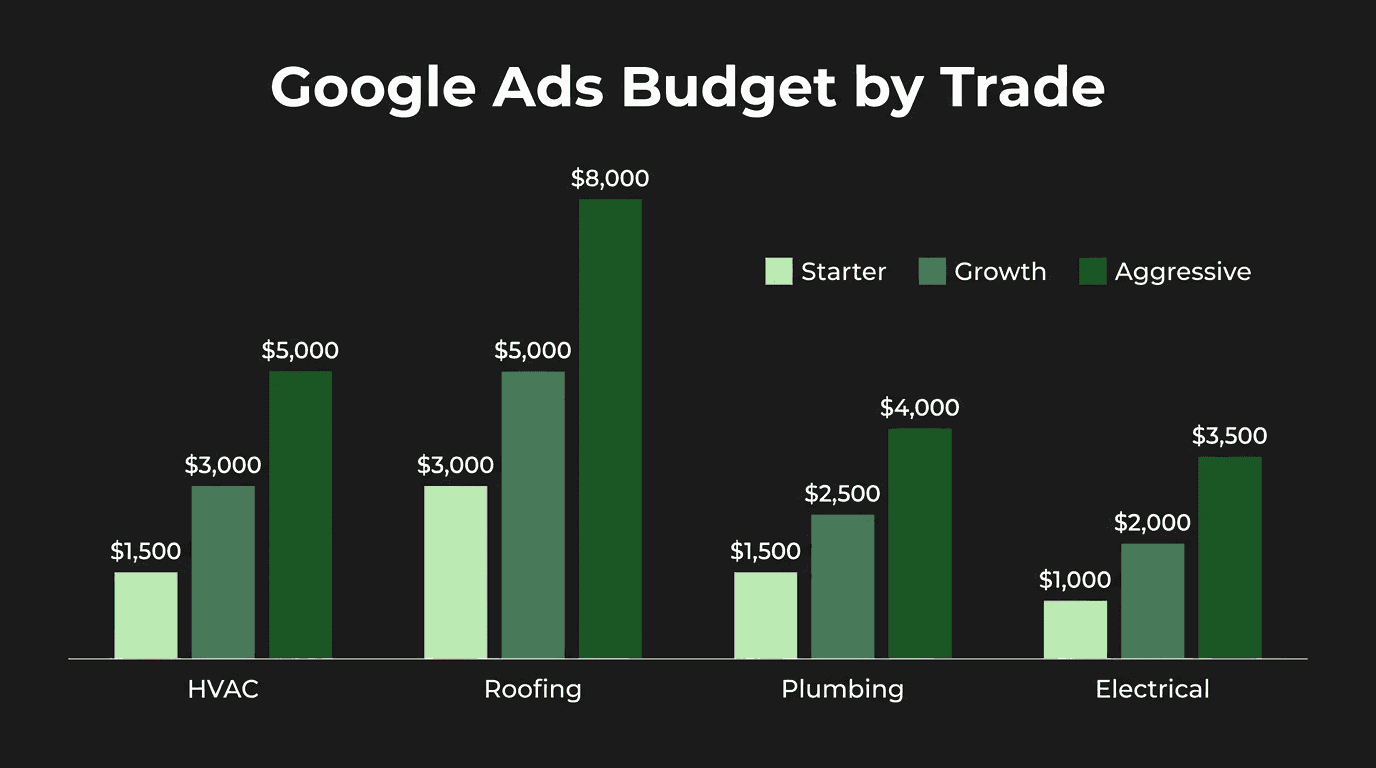
Roofing needs the biggest budget
Industry pages with more trade-specific context: HVAC digital marketing, roofing marketing, plumbing marketing, and electrical contractor marketing.
2) How Much Should You Spend?
There is no single right answer, but there are clear budget tiers that match different business goals. The key principle: you need enough budget to generate statistically meaningful data. Spending $500/month on Google Ads is like putting $2 of gas in your truck and wondering why you can't make it across town.
Starter
$1,500 - $2,500/moBest for contractors just starting with paid search or testing a single market. Works well for plumbing, electrical, and smaller HVAC operations.
- Focus on one core service (emergency repairs or installations)
- Target one geographic area (your primary service zone)
- Run 1-2 tightly focused campaigns
- Expect 20-50 leads per month depending on your trade and market
Why this works
Growth
$2,500 - $5,000/moFor established contractors ready to capture more market share. Required starting point for roofing companies in most markets due to higher CPCs.
- Cover 2-3 services (repairs, installations, maintenance or inspections)
- Expand to multiple service areas or neighboring cities
- Run separate campaigns for each service type
- Expect 50-120 leads per month
Aggressive
$5,000 - $10,000+/moFor home service companies that want to dominate their market and have the capacity to handle volume. Roofing companies in storm-prone markets often operate at this level.
- Full coverage across all service lines
- Broad geographic targeting across your entire service area
- Competitor conquesting and brand defense campaigns
- Expect 120-300+ leads per month
Capacity check first
3) What Determines Your Cost Per Click
Home service keywords are among the most expensive in local advertising. Understanding what drives your CPC helps you set realistic expectations and find opportunities to pay less per click regardless of your trade.
Competition Level
In a market like Phoenix or Houston, you might pay $25–$35 per click for "AC repair near me" or $40+ for "roof replacement." In a smaller city with fewer advertisers, the same keyword might cost 40–60% less. More advertisers bidding on the same terms drives prices up across every trade.
Location
Dense metro areas with high cost of living consistently show higher CPCs. Tampa, Dallas, and Atlanta typically run 20–40% higher than national averages. Rural markets can be significantly lower. Your geographic targeting directly impacts your average CPC in every trade.
Service Type
Emergency and replacement keywords cost the most because they have the highest intent and job value. "Emergency plumber" and "roof replacement estimate" sit at the top of CPC ranges in their respective trades. Maintenance and inspection keywords are cheaper but build your customer base.
Quality Score
Google rewards relevance. If your ad copy, keywords, and landing page all align, Google gives you a higher Quality Score and you pay less per click. A Quality Score of 8–10 can reduce your CPC by 30–50% compared to a score of 4–5 — regardless of what trade you are in.
Time of Year
Seasonality affects every trade differently. HVAC CPCs spike during heat waves and cold snaps. Roofing CPCs surge after major storms and in spring inspection season. Plumbing emergency CPCs rise in winter when pipes freeze. Electrical panel upgrade keywords climb in spring and summer as homeowners tackle projects. Smart advertisers plan budgets around these trade-specific cycles.
Mix high-intent and lower-cost keywords across every trade
4) Realistic Timeline Expectations
Google Ads is not a set-it-and-forget-it platform. Every campaign needs time to collect data, optimize, and scale. Here's what a realistic timeline looks like when you're starting from scratch or rebuilding an underperforming account — regardless of trade.
Data Collection Phase
Week 1-2Your campaigns go live and start collecting impressions, clicks, and (hopefully) conversions. Do not make major changes during this window. Google's algorithm needs time to learn who to show your ads to. Expect higher costs and lower conversion rates during this phase. That is normal.
Initial Optimization
Month 1With 2-4 weeks of data, you can start making informed changes. Add negative keywords to filter out junk searches. Pause underperforming ad variations. Adjust bids by device and time of day. This is where a skilled manager earns their fee.
Pattern Recognition
Month 2-3Now you have enough data to see real patterns. Which keywords generate calls versus tire-kickers? What time of day converts best? Which service areas are most profitable? This is when your cost per lead starts dropping consistently.
Scale and Refine
Month 3-6With proven conversion data, you can confidently increase budget on what works and cut what does not. Add new service campaigns, expand geographic targeting, and test new ad copy. Most contractor accounts hit their stride around month four or five.
The 90-day commitment
5) Common Budget Mistakes
These are the budget mistakes we see home service contractors make over and over. Each one burns money and delays results.
Spending too little to get data
Spreading too thin across services
Not tracking conversions
Cutting budget during slow season
Using the wrong keywords for your trade
6) How to Calculate Your Target Cost Per Lead
Forget industry benchmarks for a moment. The number that actually matters is what a lead is worth to your business. Work backwards from revenue to find your maximum cost per lead. The math works the same for every trade.
The Math (Plumbing Repair Example)
The Math (Roofing Replacement Example)
That's why roofing companies can sustain $40-per-click keywords — the math still works dramatically in their favor. Now do the same calculation for electrical panel upgrades ($4,000–$8,000 average job) and HVAC system replacements ($5,000–$8,000). High CPCs become less scary when you anchor them to real job values.
The Math (Electrical Panel Upgrade Example)
Do this for every service you advertise
7) When to Increase (or Decrease) Your Budget
Scaling your Google Ads budget is not about throwing more money at ads. It's about recognizing the signals that tell you it's time to invest more or pull back — and those signals are the same across every trade.
Scale Up When:
- Your cost per lead is at or below your target for 4+ consecutive weeks
- Your conversion rate is stable (not dropping as you spend more)
- Leads are profitable after factoring in close rate and job value
- You have capacity to handle more calls (or can hire to meet demand)
- Your impression share is below 70%, meaning you're missing searches due to budget
Pull Back When:
- xCost per lead has been rising for 3+ weeks with no clear cause
- xLead quality is declining (lots of calls that do not convert to jobs)
- xYou are at capacity and leads are going unanswered
- xYour ROAS drops below 2:1 consistently
The 20% rule for scaling
8) Seasonal Budget Adjustments by Trade
Each trade has its own demand cycle, and your ad budget should reflect that. The companies that win are the ones who shift budget with demand instead of keeping a flat spend all year. Here is how the four major trades differ.
HVAC Seasonality
Peak demand: May–August (cooling) and December–February (heating). Shoulder seasons are March–April and September–October — great for maintenance campaigns at lower CPCs. Budget 130–150% of your monthly average during peak months.
Roofing Seasonality
Peak demand: April–October for inspections and replacements, with storm-driven spikes that are unpredictable. Roofing is highly weather-dependent — be ready to increase budget aggressively (2x–3x) within 48 hours of a major hail or wind event in your market. Budget automation rules or a responsive agency are essential.
Plumbing Seasonality
Plumbing emergency demand stays relatively consistent year-round, but freezing temperatures drive large spikes in northern markets. Water heater replacements peak in fall and winter. Drain and sewer calls are fairly evergreen. Plumbing companies can run a steadier budget than HVAC or roofing, with modest bumps in winter.
Electrical Seasonality
Electrical demand peaks in spring and summer as homeowners tackle projects, add EV chargers, or upgrade panels before selling. Holiday seasons also drive electrical call volume. Electrical is among the most evergreen of the four trades, making it a strong candidate for consistent year-round spending.
| Month | HVAC | Roofing | Plumbing | Electrical |
|---|---|---|---|---|
| Jan–Feb | 130% | 60% | 120% | 80% |
| Mar–Apr | 100% | 120% | 100% | 110% |
| May–Jun | 130% | 140% | 100% | 120% |
| Jul–Aug | 150% | 130% | 100% | 130% |
| Sep–Oct | 90% | 110% | 100% | 110% |
| Nov–Dec | 100% | 70% | 110% | 100% |
Percentages are relative to each trade's own monthly average. A roofing company at 60% of average in January is appropriate — not a sign to stop advertising entirely. Storm events override all seasonal patterns for roofing.
Shoulder season opportunity across all trades
Universal Seasonal Tips
- Start ramping seasonal campaigns 4–6 weeks before peak season. By the time peak hits, your Quality Scores are higher and your CPCs are lower than late entrants.
- Run maintenance and service agreement campaigns year-round at a low budget. These build your customer base for future high-value repair and replacement jobs.
- Keep brand campaigns running 12 months a year. If someone searches your company name, you want to own that click, not a competitor.
- Review last year's data each quarter to fine-tune seasonal shifts. Your local weather patterns and market may differ from national averages.
- Set budget automation rules to increase spend automatically after major weather events — especially for HVAC and roofing.
Putting It All Together
Google Ads works for home service contractors when you approach it with the right budget, realistic expectations, and a plan to optimize over time. Start with at least $1,500/month focused on your highest-value service. Commit to 90 days before judging performance. Track every conversion. Calculate your target cost per lead based on real job values — not industry averages. And adjust your spending with the seasons and weather events specific to your trade.
The contractors that succeed with Google Ads are not the ones spending the most. They're the ones spending smart: focused campaigns, proper tracking, and patient optimization. For more trade-specific paid search guides, see our articles on roofing PPC, Google Ads for plumbers, electrician advertising, and digital marketing for contractors. Or if you want help building a strategy tailored to your market and budget, we specialize in home service digital marketing and can put together a custom plan.
